
Two Crops That Pay For Themselves Year After Year
(And that the deer and rabbits won’t touch!)
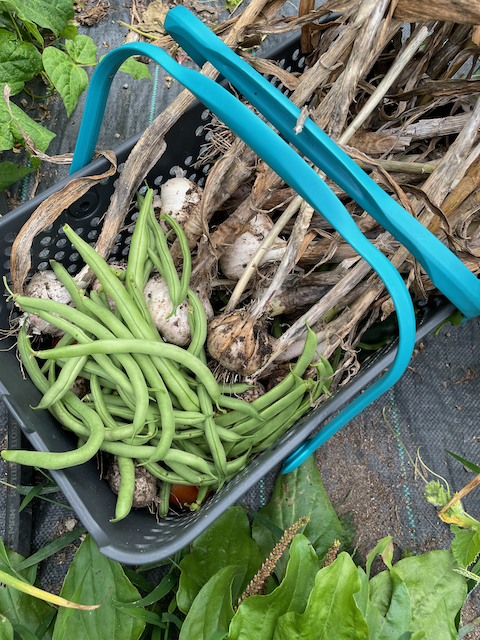
When people tell me they don’t have time to garden, I get it. Most of us are juggling work, kids, aging parents, and about 47 open browser tabs in our brains.
That’s exactly why I love growing onions and garlic.
They’re easy. They’re useful. They don’t need babysitting. And they quietly give you a lot of food for very little effort.
So, if you’ve ever thought, “Why would I grow onions and garlic when I can just buy them at the store?” — here are six reasons these two deserve a permanent spot in your garden.
If you want to make sure you can actually harvest what you grow…make sure you check out reason #6!
1. You Get Edible Harvests You Can’t Easily Buy
When you grow onions and garlic, you don’t just get the final bulbs. You also get:
Green garlic (young garlic plants before bulbs form)
Garlic scapes (the curly flower stalks from hardneck garlic)
Spring onions and green onions at different stages
Scapes, in particular, are extraordinarily rare in grocery stores. In fact, they’re so rare in general that when I searched for a stock image of “garlic scapes” to use in this post, my stock photo source didn’t have a non-AI image available. Apparently I’ll have to find a way to get pretty photos of my own this summer. I have found scapes at some CSA farm stores, but it’s hit or miss. I like growing my own because they are tender, mild, and amazing in stir-fries, eggs, soups, and pasta. I had so many last summer that I chopped them up and froze them. I’ve been adding them to meals a few tablespoons at a time during the dark days of winter as a reminder that the sun will return!
Scapes are my favorite bonus harvest. Yummmm….
2. Homegrown Really Does Taste Better
Store-bought garlic and onions are often months old by the time you buy them. That age impacts flavor and the nutritional content of all produce, including garlic and onions. On the other hand, homegrown bulbs:
Are firmer and tighter
Have more complex, aromatic flavor
Tend to be less harsh and sulfur-heavy
The difference in garlic is especially pronounced:
Store garlic = sharp, sometimes almost burning
Homegrown garlic = still strong, but smoother and more flavorful
Onions are more subtle, but still sweeter and fresher when homegrown.
Growing your own garlic also lets you match your garlic to your cooking preferences. Until I grew my own garlic, I had no idea that there could be so much flavor variation in those little bulbs. Some are spicier and more pungent while others are more mellow. Some become sweeter with baking, while others are mellow enough to use raw (and still be around other humans with functioning noses).
3. They’re the Base of Half Your Meals Anyway

The start of dinner most evenings at the Brewer household
Think about how many recipes start with:
“Chop an onion…”
“Add garlic…”
Pasta sauces. Stir-fries. Soups. Curries. Rice dishes. Roasted vegetables.
When you grow them, you always have the basics on hand - no more running to the store for something simple but critical. Plus, every time I start cooking with something I grew myself, the little cheerleader in my head says, “Look at you, Mama! You’re feeing your kids the very best - food from the garden! You are a rockstar!” That cheerleader is usually drowned out by my inner critic, who is much louder. So if I can do something that gets me feeling good about myself, I’ll do it as much as I can.
4. They Can Become Free, Year After Year

Garlic is especially magical this way.
Once you grow it you can:
Save some of your harvest
Replant cloves in the fall
Harvest again next summer
Repeat forever
Onions can be similar you can save seeds from flowering onion plants or replant from sets or starts.
Even if you’re growing in:
Raised beds
Containers
Small spaces
You’ll still cut down on what you buy at the store — and avoid paying farmers market prices for basics.
5. They’re Shockingly Easy (Which Makes It Fun)
[PHOTO: Garlic scapes curling in the garden]
These are two of the lowest-drama crops you can grow.
They:
Tolerate cold well
Rarely have serious pest issues
Don’t need daily attention
Grow quietly while you focus on everything else in life
And there’s something very satisfying about:
Pulling a full garlic bulb out of the ground
Snipping curly garlic scapes in early summer
Seeing tidy rows of upright green leaves
Big reward. Minimal fuss.
My favorite combination.
6. Critters Leave Them Alone




This one matters a lot in suburban Michigan. Nothing is more frustrating than spending an entire season growing gorgeous food - only to have the critters feast on it before you have a chance to pick it. Rabbits, groundhogs, squirrels, deer - they’re all just waiting for those tomatoes to ripen. But like picky children, they don’t want to eat raw onions or garlic. The smell is too strong (thanks to the sulfur compounds).
That means:
You can plant them outside fenced gardens
They work in front yards, side yards, and mixed flower beds
They don’t compete for your limited “inside the fence” space
If you’ve ever had to decide which crops deserve protection and which ones are basically deer snacks… these two don’t need protection.
All you need is some sunshine and some moderately loose soil (they can’t grow in compact clay) and you can grow onions and garlic. (Just make sure that if you spray your yard with any chemicals - which I NEVER encourage - that the onions and garlic are well away from the spray or drift zones.)
Want Help Figuring Out Where These Fit in Your Yard?
If you’re not sure:
Where to plant
How much to plant
Or how to build a garden that actually fits your time and space
That’s exactly what I help with through Healthy Backyard Gardens and Garden School programs here in Washtenaw County. Reach out and we’ll find the best solution for YOU.
The Best Raised Beds for Suburban Michigan Gardens
It all begins with an idea.

A potager-style cedar kitchen garden bed setup.
If you’re a busy Michigan family dreaming of a backyard garden but feeling unsure about which raised bed kit to choose, you’re not alone. Most people want a garden they can rely on—not a project that adds more stress to life. Choosing a raised bed feels like a big decision for a reason: it needs to be safe for your family, it needs to look good in your yard, and it needs to hold up to real life… including kids running full speed with pool noodles. This guide is designed to simplify that decision and give you confidence moving forward.
Why Raised Beds Make Gardening Easier (and Prettier)
Michigan backyards are charming, but they come with quirks. Raised beds solve most of them.
1. Shade, shade, and more shade
We have trees. We love trees. But vegetables don’t love trees.
Raised beds let you make the most of the sunny pockets you do have — and when you dress them up with trellises and flowers like nasturtium and zinnias, they become a focal point instead of an intrusion.
2. The clay (or sand) soil situation
Thanks to the glaciers, southeast Michigan has a bizarre mix of both clay and sand - sometimes in the same yard. Clay soil is dense, hard to dig, drains poorly, and holds water long enough to drown tender roots. Sandy soil comes with its own issues - it drains too quickly (plants dry out) and it doesn’t retain nutrients for plants to absorb.
Raised beds sidestep all of this. You start with fresh, well-amended soil that plants can actually grow in, and because no one ever steps inside the bed, that soil stays loose, aerated, and productive. Instead of fighting your native soil year after year, a raised bed gives you a controlled environment where your plants finally have the conditions they need to thrive.
3. Deer, critters, and insects
Protective garden fabrics aren’t just a nice add-on — they solve several real Michigan problems at once. Early spring and late fall cold snaps can wipe out young plants overnight, and lightweight fabric adds the few critical degrees needed to keep them alive. The same structure keeps out deer, rabbits, chipmunks, and insects that routinely destroy gardens in urban and suburban yards. With hoops and fabric in place, you create a controlled environment that shields your plants from temperature swings and persistent pests, dramatically increasing your chances of a successful harvest.
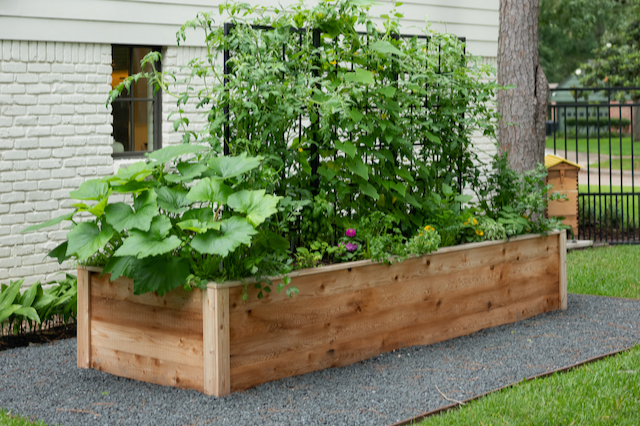
A bed with trellises installed by a Garden Consultant at a client site.
A Design to Implement Now, Add to Over Time
If you want something that works beautifully with very little fuss, start here:
One 4×8 cedar bed
Two strong trellises for vertical growing
Simple irrigation so you’re not dragging a hose every evening
Hoops + garden fabric for cold snaps, deer, and pests
A few flowering plants to make the whole setup look like intentional outdoor décor
This is the system that lets you grow more food in less space — and it’s the one I use as the base of my own gardens. When it’s placed in the right spot, it’s easy to add other beds - 4X4, 3X6, or more 4X8 beds in an aesthetically pleasing and highly functional manner.
Why I Turned My 24’ X 32’ Row Garden Into a Collection of Raised Beds
I grew up helping my mother in her (extraordinarily large) garden. My mother, like my grandmother and my great-grandmother who lived nearby, gardened in rows. We had rows of corn, rows of beans, rows of carrots, rows of…well, you get the idea. Those rows required LOTS of work to maintain. They had to be weeded regularly, as did the space between them (roughly 30”). They had to be rototilled each year and amended with compost or manure that got rototilled into the soil in the spring. In a constantly-maintained garden, they looked charming and organized. But even one week of vacation would result in an overgrowth of weeds in and between the rows - and then it just looked like a mess. In addition, the weeds would compete with the plants for nutrients, so the plants we WANTED to grow would struggle. I thought this was simply how people gardened.
When I started gardening here at our house in Saline, I built a garden full of (much shorter) rows - just as I’d been taught. But without the benefit of my dad’s farm equipment (think BIG rototiller - not the little wimpy ones we get at Home Depot) and the manure from actual farm animals (my HOA doesn’t allow sheds - I can’t imagine what would happen if I got a cow), I quickly learned that traditional row gardening was a lot of back-breaking work and not particularly space-efficient. So I added (3) 4’ X 8’ raised beds. The first three are 30” tall - which is great for days when my knees hurt, but a lot of work to keep filled from year to year. So last year, I turned the remaining part of the garden into a collection of 4’ X 8’ X 1’ beds. I filled each bed with 8 large plants, plus vining plants, two rows of beans on each long edge, and dozens of lettuce, chard, bok choy and other greens as fillers between the large plants in the spring. I had no idea if it would work, or if I’d end up with a big mess of plants growing together, but not producing much food.
I was pleasantly surprised.
Not only did everything grow well, all my plants thrived. I had very few weeds, because there was no space for them to take hold. Every space was filled with something - as as the large plants (tomatoes, eggplants, zucchinis, etc.) grew, I harvested the greens between them. When the beans were done, I planted more greens in their spots for a fall harvest. I had to water less. I got more food. And the plants all seemed happier. And the best part was that when other people came into the garden, there was no confusion about “where can I step?”. Paths are clear - they’re the spots between the beds. Feet stay out of beds - and the soil in them stays light and fluffy.
Now I’m a raised bed convert. As I age, I will probably increase the height of my beds to 24”, to make it easier on my knees. For now, I am happy with 12” beds - I have 5 years of garden soil underneath the beds, plus the new soil that was added last year. I’ll add compost and mulch each year, and if needed, I can have my landscaper bring a few yards of soil for me. But I will never rototill again.
So…Are Raised Bed Kits Actually Worth It?
While I personally build my beds and those for my customers from locally sourced cedar, those who want a kit can find plenty of options. The following are two of the options that my fellow Garden Consultants rave about. Don’t forget - even if you want a kit, you can always contact me for help getting everything installed correctly.
Gardenary Cedar Raised Bed Kits
My favorite for Michigan yards.
Cedar looks like it belongs here. It weathers beautifully, stands up to our freeze–thaw cycles, and doesn’t introduce chemicals into the soil your kids’ snacks grow in. My colleagues swear by the Gardenary cedar kits for durability and aesthetics.
If you’re going to invest once and enjoy it for a decade, cedar is hard to beat. Why cedar works so well here:
Naturally rot-resistant
No chemical treatments
Warm, classic look that blends into wooded Michigan neighborhoods
Long lifespan with minimal upkeep
I personally source cedar locally through Facebook Marketplace and build my own beds — but if you’d rather skip the tools and sawdust, Gardenary’s kits are an excellent choice.
Vego Metal Raised Bed Kits
Modern, durable, and very popular.
Vego beds are sleek and configurable, and the powder-coated metal holds up well in our climate. They give small yards a modern, tidy look.
They’re wonderful for families who prefer steel or want something exceptionally low-maintenance. Just know they’ll visually stand out more than cedar in a typical Michigan yard.
What to Avoid (Please Trust Me on This One)
If you remember only one thing from this entire post, let it be this:
No treated lumber and no plastic beds.
Treated lumber leaches chemicals directly into your soil — into your lettuce, your tomatoes, and eventually your kids’ lunches.
Plastic breaks down over time. Microplastics don’t belong in carrots.
If you’re building a garden to nourish your family, your materials should support that goal, not undermine it.
The Busy Family Checklist for Choosing Your Raised Bed
✔ Enough sunlight in the specific spot you’ll use
✔ Safe, non-toxic materials (cedar or galvanized steel)
✔ Ability to add hoops for frost + deer protection
✔ A long shape (4×8) for dense planting and easy access
✔ Room for a trellis to maximize vertical space
✔ A style that complements your home and yard
✔ Fits your family’s lifestyle — including space for kids to run
This checklist exists because most families are overwhelmed by choices. When we simplify it to these essentials, the answer becomes obvious.
A Quick Word About Hiring Help
Small Michigan gardens are their own ecosystem — sunlight angles, clay soil, wildlife, aesthetics, kid-play zones, all woven together.
And there’s no shame in calling in help.
Other consultants in the U.S. build raised beds professionally as their whole business. I do, too. In fact, I design, source, and install raised beds for busy families all the time.
Because you’re not just buying wood or metal…
You’re buying clarity, safety, confidence, beauty, and a system that actually produces food.
Ready to Stop Researching and Start Growing?
If you want raised beds that are beautiful, functional, and perfectly suited to your Michigan yard, I’d love to help.
My installation spots fill quickly each spring, and early planning makes all the difference — especially if you want your first harvest sooner rather than later.
👉 Click here to see what a raised bed installation includes.
Feel that little breath of relief? Good.
Let’s get your garden growing.

Blog Post Title Three
It all begins with an idea.
It all begins with an idea. Maybe you want to launch a business. Maybe you want to turn a hobby into something more. Or maybe you have a creative project to share with the world. Whatever it is, the way you tell your story online can make all the difference.
Don’t worry about sounding professional. Sound like you. There are over 1.5 billion websites out there, but your story is what’s going to separate this one from the rest. If you read the words back and don’t hear your own voice in your head, that’s a good sign you still have more work to do.
Be clear, be confident and don’t overthink it. The beauty of your story is that it’s going to continue to evolve and your site can evolve with it. Your goal should be to make it feel right for right now. Later will take care of itself. It always does.

Blog Post Title Four
It all begins with an idea.
It all begins with an idea. Maybe you want to launch a business. Maybe you want to turn a hobby into something more. Or maybe you have a creative project to share with the world. Whatever it is, the way you tell your story online can make all the difference.
Don’t worry about sounding professional. Sound like you. There are over 1.5 billion websites out there, but your story is what’s going to separate this one from the rest. If you read the words back and don’t hear your own voice in your head, that’s a good sign you still have more work to do.
Be clear, be confident and don’t overthink it. The beauty of your story is that it’s going to continue to evolve and your site can evolve with it. Your goal should be to make it feel right for right now. Later will take care of itself. It always does.